
Effective resource management in Kubernetes environments is crucial for optimizing application performance and reducing operational overhead. Autoscaling solutions play a vital role in dynamically adjusting resource allocation based on workload demand. In this article, we’ll compare ScaleOps, Horizontal Pod Autoscaler (HPA), Vertical Pod Autoscaler (VPA), and Kubernetes-based Event-Driven Autoscaling (KEDA) to understand their differences and strengths.
Understanding Autoscaling
Autoscaling in Kubernetes enables automatic resource allocation adjustment to meet changing workload demands, ensuring optimal performance and resource utilization.
Cluster Autoscaler
Cluster Autoscaler adjusts the size of the Kubernetes cluster itself by adding or removing nodes based on resource utilization and pod scheduling. It examines pod resource requests and scheduling constraints to determine whether additional nodes are required to meet demand or if existing nodes can be safely removed to optimize resource utilization. This dynamic scaling ensures efficient resource allocation and can handle sudden increases in workload demand by automatically provisioning new nodes as needed. By considering both pod resource requests and scheduling constraints, Cluster Autoscaler effectively balances resource availability and workload distribution within the Kubernetes cluster.
Karpenter is a well-maintained and widely used open-source tool that takes a more proactive approach to scaling compared to Cluster Autoscaler. It provisions individual nodes directly in your cloud provider, tailoring them to the specific resource requirements of unscheduled pods. This leads to better resource utilization and potentially lower costs.
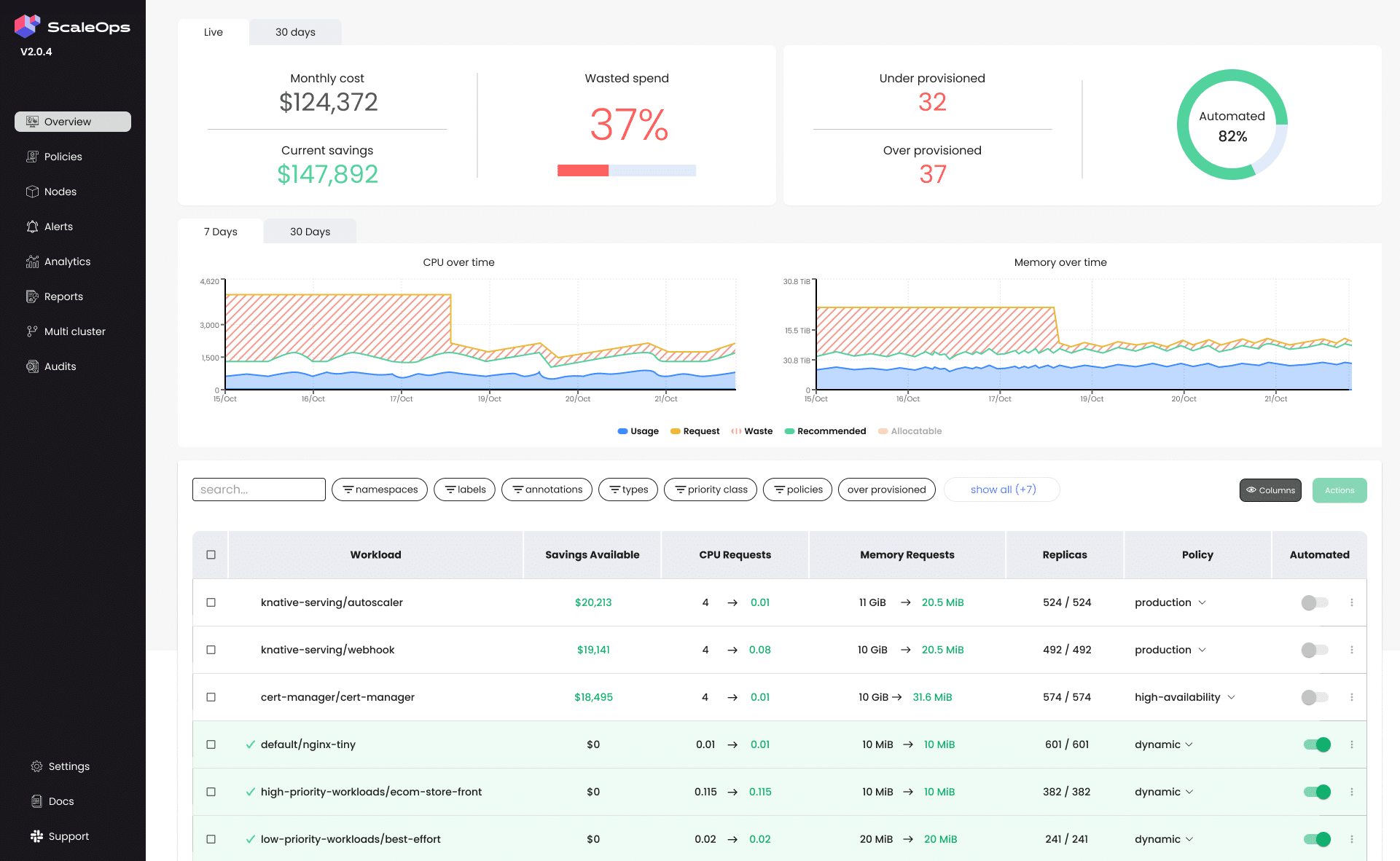
- Cost reduction: By integrating with and enhancing the functionality of all autoscaling tools within Kubernetes, ScaleOps ensures efficient resource allocation, reducing the risk of over-provisioning and unnecessary infrastructure costs. Furthermore, its streamlined management capabilities minimize operational overhead, leading to substantial cost savings while maintaining high-performance levels.
- Performance: ScaleOps optimizes application responsiveness, latency, and user experience by harnessing the capabilities of Dynamic Scaling in dynamic resource allocation and scaling.
- Scalability: ScaleOps leads in scalability, leveraging its integrated approach to combine the capabilities of Dynamic Scaling seamlessly. This integration ensures efficient scaling across varying workload demands, enabling organizations to adjust resource allocation and meet changing requirements dynamically.
- Flexibility: ScaleOps provides unparalleled flexibility by adapting to different workload types and resource requirements through its integration with Dynamic Scaling. This comprehensive solution allows organizations to tailor scaling strategies to their specific application architectures and business needs, ensuring optimal performance and resource utilization.
- Zero onboarding time: ScaleOps automatically identifies the workloads needed and attaches them to the best scaling policy, so teams don’t need to spend time learning and tailoring their own policy. ScaleOps does it out of the box.